The Rise of Autonomous AI Agents and the Audit Imperative
AI agents are no longer confined to research labs. They execute trades, manage DAOs, and interact with smart contracts autonomously. As these agents gain access to on-chain assets, the need for verifiable auditing becomes critical. Without proof that an agent acted correctly, trust is blind.
Solana, with its high throughput and low transaction costs, offers a natural home for agent-driven economies. But how can we ensure that an agent’s decisions are honest and its execution is correct? The answer lies in verifiable proofs — cryptographic guarantees that an agent followed its stated rules.
What Are Verifiable Proofs for AI Agents?
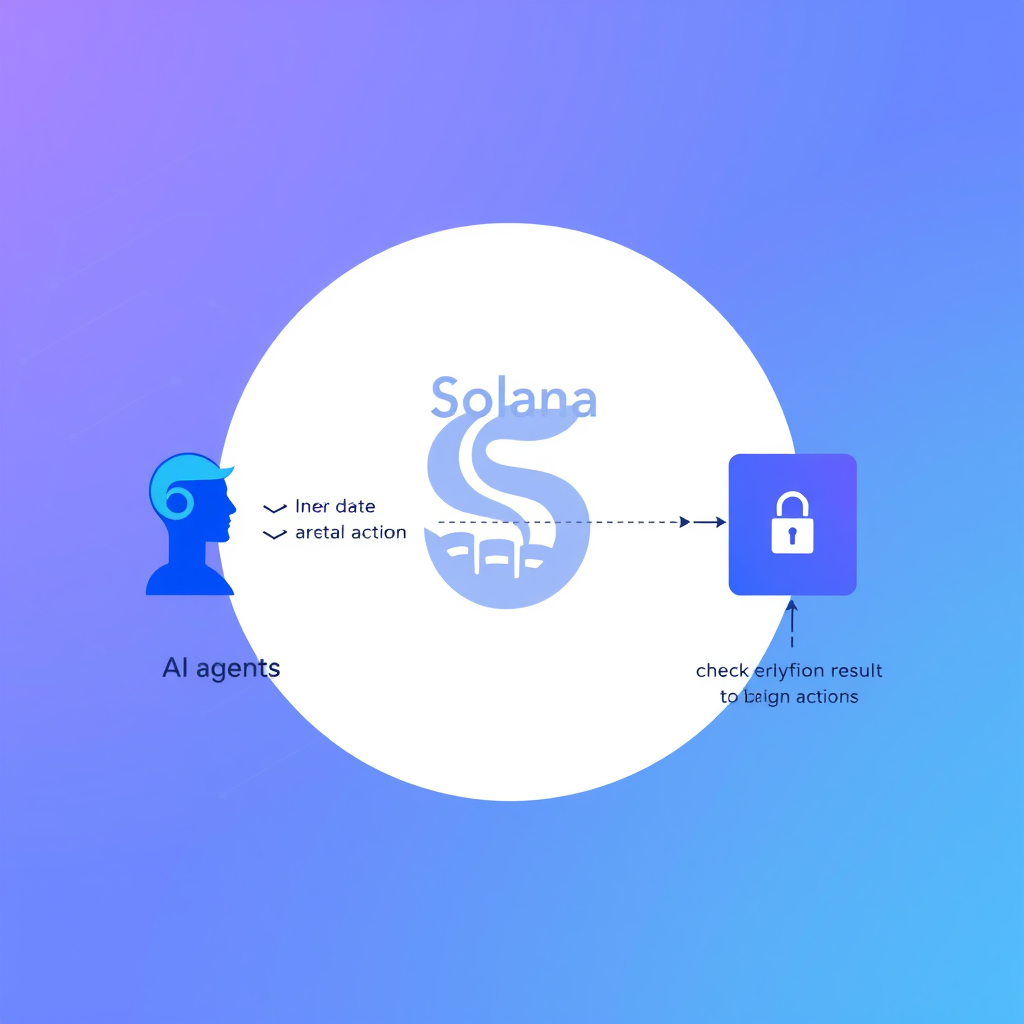
A verifiable proof is a compact, cryptographic certificate that attests to the correct execution of a computation. For AI agents, this means proving that a specific input (e.g., market data) led to a specific output (e.g., a trade) according to the agent’s logic.
Common techniques include:
- Zero-Knowledge Proofs (ZKPs) — the agent can prove it followed its policy without revealing sensitive data.
- Optimistic fraud proofs — a challenger can dispute an agent’s action, and the network verifies the claim.
- Trusted Execution Environments (TEEs) — hardware-backed attestations that the agent ran inside a secure enclave.
Each approach has trade-offs in speed, cost, and privacy. On Solana, the low latency and high block limits make ZK-based verification particularly attractive.
Why Solana Is a Natural Fit for On-Chain Verification
Solana’s architecture is uniquely suited for verifiable proof systems. Its Sealevel runtime allows parallel execution of smart contracts, meaning multiple agent verifications can happen simultaneously.
Key advantages include:
- Low fees — verifying a ZK proof on Ethereum can cost hundreds of dollars; on Solana it is fractions of a cent.
- Fast finality — sub-second block times enable near-real-time auditing of agent actions.
- Native support for Ed25519 signatures — the same curve used in many ZK schemes reduces overhead.
Projects like Light Protocol and zkPass are already exploring Solana-based verifiable computation. For AI agents, this means auditors can run continuous, trustless checks without waiting for expensive L1 confirmations.
Challenges and the Road Ahead
Despite the promise, several hurdles remain. Proof generation for complex AI models is computationally heavy — a single forward pass of a neural network may require millions of constraints in a ZK circuit. Optimizing these circuits for Solana’s instruction limits is an active area of research.
Another challenge is agent determinism. An agent’s behavior must be fully deterministic to produce reproducible proofs. Stochastic elements (e.g., random seeds) must be handled carefully.
“Verifiable AI agents are not just a technical problem — they are a coordination problem. We need standards for what constitutes a valid proof and how agents register their policies on-chain.” — Anonymous Solana developer.
Looking forward, we can expect hybrid models that combine ZK proofs with optimistic verification, and proof aggregation techniques that batch multiple agent actions into a single succinct proof. The Solana ecosystem is well-positioned to lead this evolution.
Conclusion: Trust Through Cryptography
Verifiable proofs transform AI agents from black boxes into accountable actors. By anchoring proofs on Solana, we gain transparency without sacrificing speed or cost. The next wave of DeFi, gaming, and autonomous organizations will rely on these cryptographic guarantees.
For developers, the message is clear: start designing your agents with verifiability in mind. The tools are emerging, the network is ready, and the demand for trust is only growing.